


Introduction to Nylon as an Engineering Material
Nylon, also known as polyamide (PA), is one of the most widely used engineering plastics in modern industry. It is valued for its excellent combination of strength, wear resistance, and chemical stability, particularly when utilized as nylon bushings for semiconductor tools. According to the ASTM D6779 Standard Classification, polyamides offer a unique balance between mechanical performance and lightweight design, making them an ideal choice for cost-effective nylon replacement parts for industrial machinery.
From a chemical perspective, nylon is formed through a polymerization process that links small molecular units into long-chain structures. This molecular arrangement gives nylon its toughness, flexibility, and resistance to repeated mechanical stress. As a result, nylon performs reliably in both dynamic and static applications, including specialized industrial nylon component manufacturing for wind turbine systems.
One of the most important characteristics of nylon is its low coefficient of friction. This allows nylon parts to operate smoothly in contact with metal or other materials, often without the need for continuous lubrication. In addition, nylon provides good resistance to oils, fuels, and many chemicals, which makes it suitable for harsh working environments and the production of corrosion-resistant plastic bushings for pumps and valves. Because of these advantages, nylon is not only used as a raw material but is also widely manufactured into functional components such as bushings and spacers.
Nylon Components: Bushings and Spacers
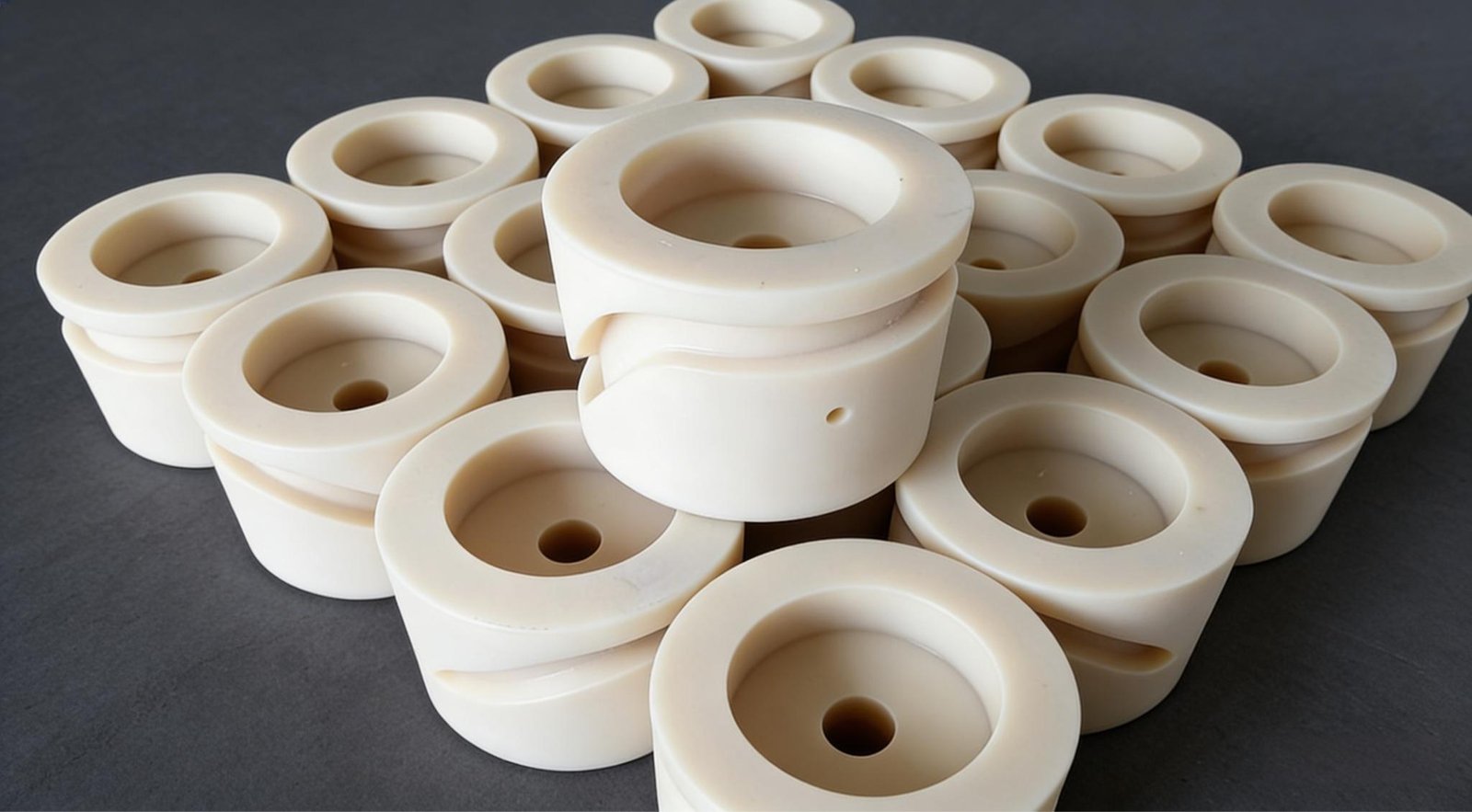
In industrial applications, nylon is commonly processed into two important types of components: bushings and spacers. These parts play different roles in mechanical systems, but both benefit from nylon’s unique material properties. Custom CNC machined nylon bushings are primarily used in moving systems to reduce friction and support rotating shafts, while custom nylon spacers are used to maintain precise distances between components and ensure proper alignment. Together, they contribute to the stability, efficiency, and longevity of mechanical assemblies.
Nylon Bushings
What Are Nylon Bushings?
Nylon bushings, also known as sleeve bearings, are cylindrical components installed between a shaft and a housing. Their main function is to reduce friction, prevent wear, and ensure smooth rotation or sliding motion.
Unlike metal bearings, nylon bushings do not require constant lubrication. Their self-lubricating nature allows them to operate efficiently even in environments where lubrication is difficult or undesirable.
Advantages of Nylon Bushings
Nylon bushings offer several performance advantages in mechanical systems, making them a preferred alternative to traditional metal bearings. Their key benefits include:
-
Superior Wear Resistance: Nylon provides excellent durability, which significantly helps extend the service life of both the bushing itself and the mating metal components by minimizing surface abrasion.
-
Vibration and Noise Reduction: One of the standout features of nylon is its ability to absorb vibration. This dampening effect reduces operational noise and improves the overall stability and smoothness of mechanical assemblies.
-
Self-Lubricating Properties: Most nylon grades exhibit a low coefficient of friction, allowing for efficient operation without the need for constant external lubrication. This is ideal for applications where maintenance is difficult.
-
Excellent Corrosion Resistance: Unlike metal, nylon does not rust or oxidize. It performs exceptionally well in humid conditions or chemically aggressive environments where moisture and salts are present.
-
Lightweight Design: The low density of nylon reduces the overall weight of equipment. This is particularly critical for energy efficiency in automotive interior vibration reduction and high-speed moving machinery applications.
-
High Load-Bearing Capacity: When produced as custom cast MC nylon parts for large-scale industrial equipment, these bushings can support significant loads while maintaining dimensional stability.
Applications of Nylon Bushings
As a leading nylon bushing manufacturer, we provide solutions focused on movement and friction reduction. Key functional roles include:
-
Rotating & Sliding Systems: Installed in conveyor rollers and sliding guides to ensure smooth motion.
-
Heavy-Duty Pivots: Replacing metal bearings in agricultural and construction joints to eliminate the need for grease.
-
Fluid Control: Serving as corrosion-resistant plastic bushings for pumps and valves in chemical processing.
Nylon Spacers
What Are Nylon Spacers?
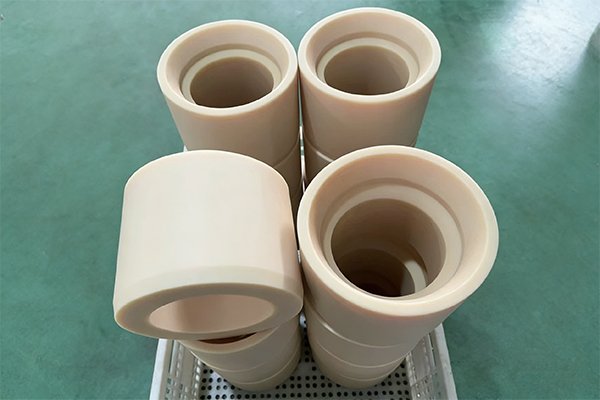
Nylon spacers are components used to create and maintain a specific distance between two parts in an assembly. They are commonly used in fastening systems, electronic devices, and mechanical structures.
Spacers can be cylindrical, tubular, or custom-shaped, depending on the design requirements. Their primary function is not to reduce friction but to ensure alignment, prevent direct contact, and distribute loads evenly.
Applications of Nylon Spacers
Nylon spacers are engineered for structural integrity and isolation. Their primary uses include:
-
Electrical Insulation: Maintaining safe gaps in circuit boards and control panels to prevent conductivity.
-
Precision Alignment: Ensuring consistent spacing in fastening systems and mechanical frameworks.
-
Surface Protection: Preventing direct contact between metal parts to avoid galvanic corrosion or scratching.

Industry-Specific Solutions
By integrating both bushings and spacers, QZSEALS delivers comprehensive performance for specialized sectors:
-
Automotive: Utilizing Nylon 66 spacers for automotive interior vibration reduction and bushings for pedal assemblies to enhance NVH performance.
-
Renewable Energy: Supporting industrial nylon component manufacturing for wind turbine systems, specifically in pitch and yaw mechanisms.
-
High-Tech Manufacturing: Providing high-performance thermoplastic bushings for semiconductor tools and non-magnetic spacers for medical imaging equipment.
-
Aerospace: Offering lightweight nylon spacers for aerospace and medical devices to meet strict weight-reduction targets.
Comprehensive Processing Methods for Nylon Components
The manufacturing process of nylon components directly affects their final performance, dimensional precision, and cost-efficiency. Depending on the specific application requirements—whether for high-precision electronics or heavy-duty industrial machinery—different processing methods are selected to achieve optimal results.
-
CNC Machining Widely used to achieve high precision and tight tolerances, CNC machining is the preferred choice for producing custom CNC machined nylon bushings. In this process, semi-finished nylon rods or tubes are machined into final parts with accurate dimensions and smooth surfaces. This method offers maximum flexibility, making it ideal for custom nylon spacers, prototypes, and small-to-medium production runs where specific, non-standard dimensions are required.
-
Injection Molding This is the most common method for the high-volume production of standardized nylon parts. When considering the advantages of injection molding vs CNC machining for nylon parts, injection molding stands out for its ability to produce complex geometries with consistent quality. While it requires a higher initial tooling investment, it is the most cost-effective solution for large-scale industrial projects requiring thousands of identical components.
-
Casting (MC Nylon) Casting is typically used for manufacturing custom cast MC nylon parts for large-scale industrial equipment. Unlike extrusion or molding, this process involves polymerizing liquid raw materials directly in a mold, resulting in a dense and uniform internal structure. Cast nylon offers superior mechanical strength and wear resistance, making it the ideal processing method for large-size or heavy-load bushings that operate in demanding environments.
-
Extrusion Extrusion is primarily used to produce continuous nylon profiles such as rods, tubes, and sheets. These act as the high-quality raw materials that are later processed into finished components. This method is highly efficient for producing standard shapes, ensuring that the base material maintains the integrity needed for further precision machining.
How to Polish Nylon Parts
Polishing is a critical step in improving the surface quality and performance of nylon components. A well-polished surface can reduce friction, enhance appearance, and improve overall functionality.
1. Coarse Grinding
The first step in polishing is coarse grinding, which removes surface defects, burrs, and machining marks. Abrasives with lower grit numbers are typically used at this stage.
It is important to control the rotation speed and pressure to avoid overheating, as nylon is sensitive to high temperatures.
2. Intermediate Sanding
After coarse grinding, intermediate sanding is performed to further smooth the surface. Finer abrasives are used to eliminate scratches and prepare the part for final polishing.
Uniform pressure should be applied to ensure an even finish and prevent surface damage.
3. Fine Polishing
In the final stage, soft polishing wheels and fine polishing compounds are used to achieve a smooth or glossy surface. For high-quality applications, a near mirror-like finish can be obtained.
Cooling methods such as water-assisted polishing may be used to prevent heat buildup and maintain dimensional stability.
4. Advanced Polishing Techniques
For specialized applications, advanced polishing methods may be required. Vibratory polishing is often used for batch processing, while precision polishing compounds are applied for optical or transparent nylon parts.
These techniques help achieve higher surface quality and are commonly used in high-end industrial or technical applications.
Conclusion
Nylon is a versatile and high-performance engineering material widely used in modern industry. Its combination of strength, wear resistance, and self-lubricating properties makes it an ideal choice for manufacturing components such as bushings and spacers. By selecting the right material grade, processing method, and finishing technique, nylon parts can deliver reliable performance even in demanding working conditions.
With extensive experience in plastic processing and precision manufacturing, QZSEALS stands out as a premier nylon bushing manufacturer, providing reliable solutions for high-quality nylon bushings, spacers, and customized plastic components for a wide range of industrial applications. From material selection to final machining, we ensure consistent quality, tight tolerances, and dependable performance. If you are looking for durable and cost-effective nylon components, feel free to contact us for technical support and customized solutions tailored to your specific requirements.