


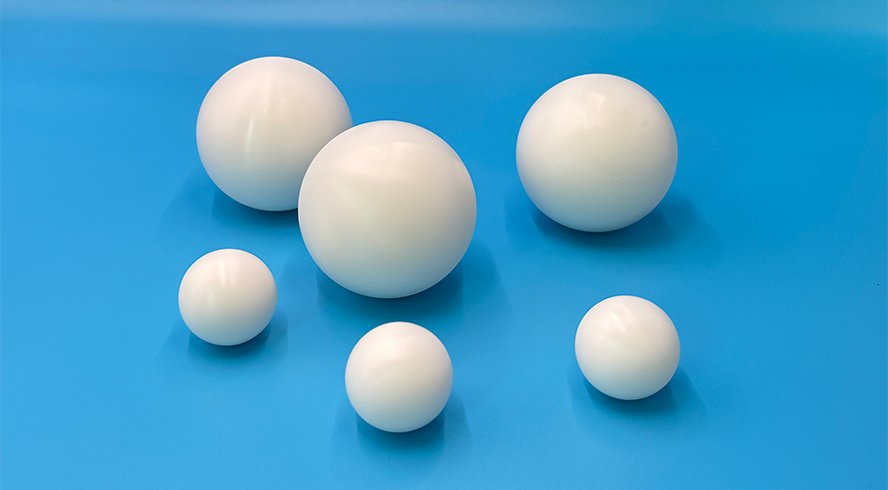
Selecting the right spherical component involves more than just picking a size; it requires a deep dive into material science. For engineers managing high-performance systems, the choice between Polyethylene terephthalate PET plastic balls and PTFE plastic balls often comes down to a battle between mechanical rigidity and chemical extreme-tolerance.
Understanding how these materials behave under load, heat, and chemical exposure is the key to preventing premature component failure.
What Are Polyethylene Terephthalate PET Plastic Balls and Where Are They Used?
Polyethylene terephthalate (PET), often known by trade names like Ertalyte®, is a semi-crystalline thermoplastic. PET plastic balls are characterized by their high density (1.3 to 1.4 g/cm³) and exceptional hardness. Unlike softer plastics, PET maintains its shape under significant stress, making it the preferred choice for high precision industrial components.
Diverse Applications of Polyethylene Terephthalate PET Plastic Balls:
-
Polyethylene terephthalate PET plastic balls for food processing equipment: In the food industry, hygiene is paramount. PET is used in hamburger molds, beverage manifolds, and conveyor belt components because it is easy to clean and resists corrosion from fats and weak cleaning agents.
-
High precision PET balls for mechanical guide components: Due to their low moisture absorption and high stiffness, these balls are ideal for linear guides, precision rollers, and sliding elements where dimensional accuracy is critical.
-
FDA compliant PET plastic balls for medical instruments: PET is physiologically inert and resistant to X-rays and Gamma rays, making it a staple in medical testing apparatus and diagnostic equipment housings.
-
Industrial Machinery: Used in steering wheels for the textile industry, container plugs, and high-load pump parts where mechanical strength must surpass conventional nylon or POM.
What Are PTFE Plastic Balls and Why Are They Called the “Plastic King”?
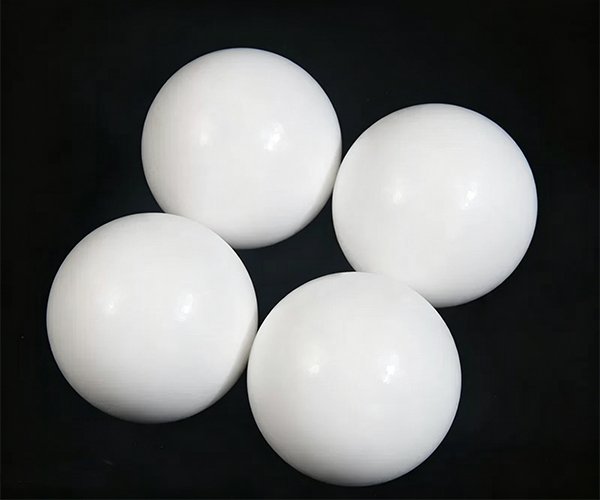
Polytetrafluoroethylene (PTFE), popularly known as Teflon, operates on a different spectrum. While PET is chosen for its “toughness,” PTFE is selected for its “invincibility.” It is a fluoropolymer with a unique carbon-fluorine bond that makes it nearly immune to chemical attack.
Why Are PTFE Plastic Balls Ideal for Corrosive Environments?
In industries dealing with aggressive media, PTFE plastic balls are often the only viable solution. They can withstand a massive temperature range, from -180 to +250℃, without losing their self-lubricating properties.
-
Extreme Low Friction: They possess one of the lowest coefficients of friction of any solid material.
-
Chemical Inertness: They remain stable when exposed to strong acids, alkalis, and organic solvents.
-
High-Purity: Excellent for PTFE plastic balls for chemical valve applications where contamination must be zero.
What Are PTFE Plastic Balls and Why Are They Called the “Plastic King”?
Polytetrafluoroethylene (PTFE), popularly known as Teflon™, operates on a different performance spectrum. While PET is chosen for its mechanical toughness, PTFE is selected for its “invincibility” in hostile environments. It features a unique carbon-fluorine bond that makes it nearly immune to chemical attack.
Diverse Applications of PTFE Plastic Balls:
-
PTFE plastic balls for chemical valve applications: Used as check valves and relief valves in systems handling concentrated acids, alkalis, and aggressive organic solvents.
-
Corrosive resistant PTFE balls for pumps and valves: Ideal for diaphragm pumps and chemical handling equipment where the ball must act as a reliable seal without sticking or degrading.
-
Extreme Temperature Environments: From cryogenic storage (down to -180℃) to high-heat industrial ovens (up to +250℃), PTFE maintains its physical properties where other plastics melt or become brittle.
-
Laboratory & Pharmaceutical: Due to its non-wettability and high purity, PTFE balls are used in stirring bars, hazardous material bottle pourers, and volume displacement balls for chemical baths.
How to Choose Between PET and PTFE Based on Application Requirements
When deciding between these two materials, you must evaluate the primary “stressor” of your application. Use the following criteria to guide your selection:
1. High Load vs. Low Friction
If your application involves high mechanical pressure and requires the ball to maintain its spherical integrity under weight, Polyethylene terephthalate PET plastic balls are the superior choice. However, if the goal is to reduce torque and prevent sticking in a non-load-bearing valve, the self-lubricating nature of PTFE is required.
2. Precise Dimensions vs. Chemical Range
PET is the winner for precision engineering because it does not “creep” or deform easily under load. Conversely, if the component will be submerged in boiling solvents or strong alkalis, you must utilize corrosive resistant PTFE balls for pumps and valves.
3. Safety and Insulation
For electronics and medical testing, PET provides superior electrical insulation and stain resistance. For food-grade applications, while both are available, PET offers better wear resistance against the abrasive nature of some food processing machinery.
| Property | PET (Ertalyte) | PTFE (Teflon) |
| Density | 1.39 g/cm³ | 2.15 g/cm³ |
| Max Temp | 100°C to 115°C | 260°C |
| Coefficient of Friction | Low (0.2–0.5) | Extremely Low (0.05–0.1) |
| Chemical Resistance | Good (Weak Acids / Oils) | Excellent (Almost All) |
| Hardness | High (Shore M90) | Low (Shore D55) |
Why Is Material Selection Critical for Long-Term ROI?
Choosing the wrong material doesn’t just cause a leak; it causes downtime. Using a PTFE ball in a high-load bearing may lead to “flat-spotting” due to its lower hardness. Conversely, using a PET ball in a high-temperature alkaline cleaning cycle will lead to material degradation and brittle failure.
For specialized systems like cryogenic LNG filling station nozzles or hydraulic cylinder wear strips, the material must be matched to the exact chemical and thermal profile of the fluid being handled.
Custom Sealing Solutions with QZSEALS
At QZSEALS, we understand that off-the-shelf components don’t always meet the rigorous demands of modern industry. We specialize in the professional customization and production of high-performance polymer components, including both Polyethylene terephthalate PET plastic balls and PTFE plastic balls.
Whether you require specific tolerances for wind turbine main bearing seals or high-purity materials for medical testing apparatus, our team provides the technical expertise to ensure your components last longer and perform better.
Contact QZSEALS today for a technical consultation or a custom quote on your industrial plastic ball requirements.